OUR CUSTOMERS

hand arm vibration MONITORING
Prevent Vibration Overexposure – Comply with ACGIH TLVs
Protect workers and your bottom line – with ACGIH-aligned HAVS monitoring from spacebands wearables.proof of vibration exposure, estimates and spreadsheets rarely hold up. Without defensible monitoring records, companies can face compensation claims, enforcement notices and significant fines.
Calculate your current exposure estimates and see how confident you would be defending them.
View online demo









Compliance Risk
Estimated exposure records are easy to challenge
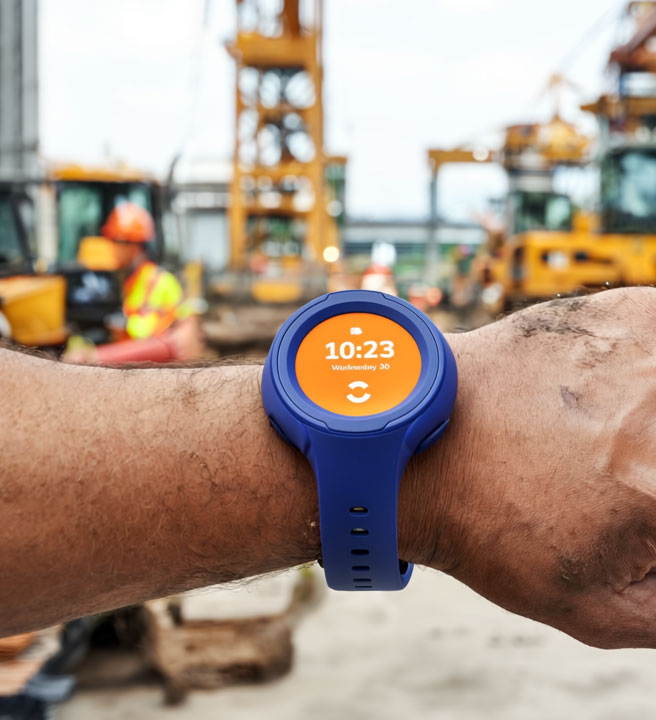
The device is a wearable wristband that uses an accelerometer to calculate when users are approaching an TLV (Threshold Limit Value Value).manual logs, spreadsheets or tool estimates to assess vibration exposure. But these records often depend on assumptions about tool usage, vibration magnitude and duration.
In investigations or legal claims, those assumptions can be questioned.
If exposure cannot be proven with reliable data, employers may struggle to demonstrate that vibration risks were properly controlled.

the hand arm vibration problem
HAVS claims and enforcement are on the rise
Across construction, manufacturing and engineering, vibration exposure remains one of the most common causes of long-term occupational illness.
In the UK alone, around 2 million workers are exposed to vibration, and legal claims for HAVS frequently exceed £100,000 when exposure records are missing or incomplete.
Beyond compensation, companies may also face enforcement action, operational disruption and increased insurance premiums.
the compliance gap
The challenge isn’t awareness. It’s evidence.
Most safety teams understand the risks of hand-arm vibration. The real challenge is proving that exposure has been assessed and controlled properly.
Manual records often rely on:
- Estimated tool vibration values
- Assumed usage duration
- Incomplete task tracking
- Paper or spreadsheet logs
These methods can give a rough indication of exposure, but they rarely provide a defensible audit trail.
exposure estimation tool
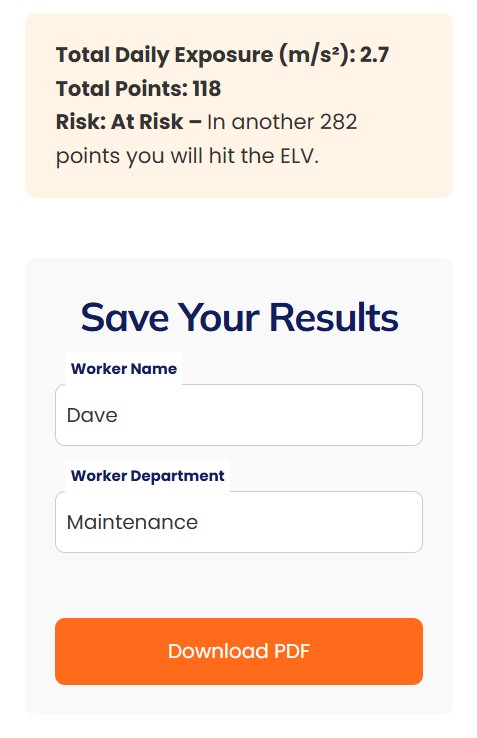
Estimate your current HAVS exposure levels
Use the HAVS exposure calculator below to estimate vibration exposure based on tool vibration magnitude and usage duration.
This provides a quick indication of whether exposure could approach regulatory limits such as the Exposure Action Value (EAV) or Exposure Limit Value (ELV) in your workplace.
Treat this as an estimate. If you ever need to defend exposure data, you’ll want measured records, not assumptions.
personal exposure measurement
Estimates are not exposure records
The results you get from the calculator are based entirely on the assumptions entered into the calculator.
In practice, vibration exposure varies depending on tool condition, working method, material resistance and actual usage time. Small variations can significantly change the true exposure level.
We've tested two workers using the same tool, for the same amount of time and the variance in exposure is eye-opening. Some workers grip tighter and push harder on vibration tools - giving them much higher HAVS exposure on the same job.
Without measured data, it can be difficult to prove exactly how much vibration a worker experienced on any given shift.
The real challenge is proving that exposure has been assessed and controlled properly.


real protection
Replace estimates with defensible monitoring
spacebands wearables measure vibration exposure automatically while tools are in use, calculating each worker’s daily A(8) exposure in real time.
Instead of relying on manual estimates, safety teams gain:
- Continuous vibration exposure tracking
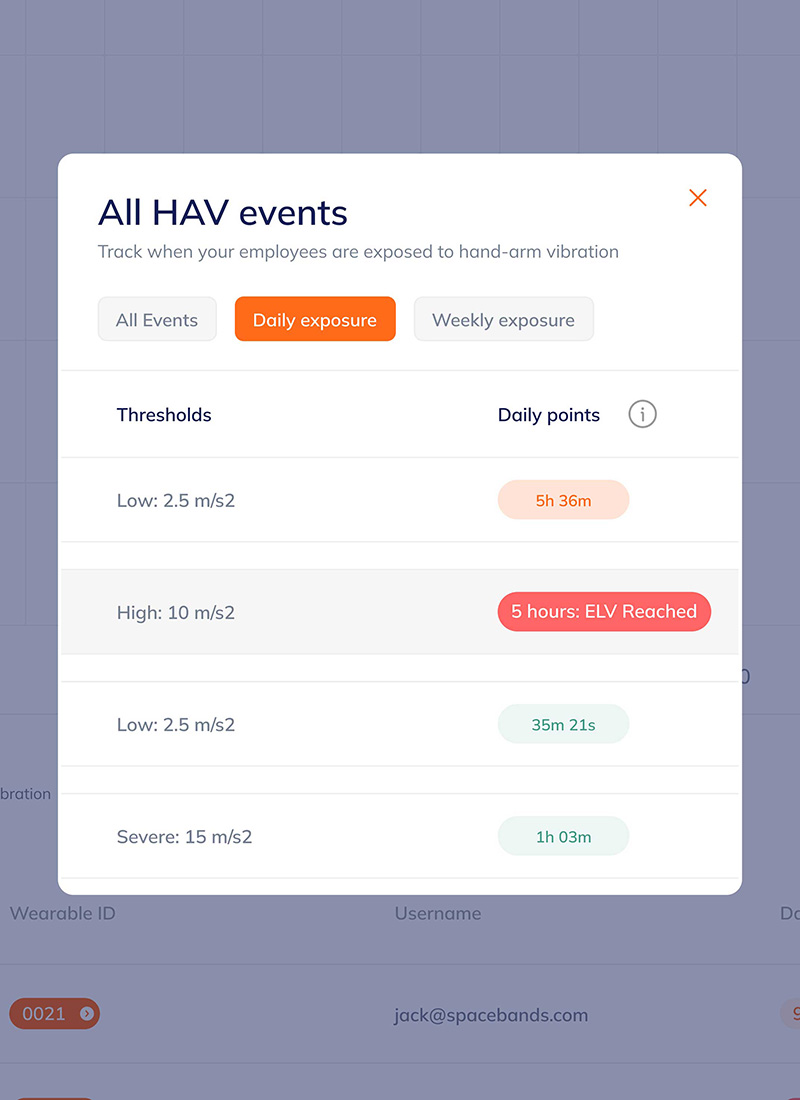
- Automatic A(8) and exposure points calculations
- Real-time alerts when limits are approached
- Downloadable exposure records for audits and investigations
- Clear dashboards showing risk trends across sites
This creates a clear and defensible record of exposure.
the spacebands solution
See how companies create defensible HAVS records

CUSTOMER FEEDBACK
Testimonials
spacebands is helping Health & Safety managers around the world reduce hand arm vibration exposure while providing a paper trail of exposure levels.

Nick S
Senior H&S Manager
spacebands has completely changed how we manage hand arm vibration exposure. Instead of chasing bits of paper and one-off HAVS meter readings, the HAVS monitoring watch gives us real-time A(8) data for every operator. We can see who is approaching EAV/ELV and take action before we breach our HSE limits.

Robert M
Health & Safety Manager
We used to rely on a traditional HAVS meter and manual logs. It was slow, reactive, and often out of date. With spacebands’ HAVS wrist monitor, exposure is tracked automatically across all tools. The dashboard gives us clear evidence for audits and has made HAVS compliance far easier to manage day to day.

Chris P
Plant Manager
The biggest win for us was visibility. The HAVS wearable monitor showed which tasks were really driving vibration exposure, not just what we assumed from risk assessments. That’s helped us reorganise work, rotate staff more intelligently, and reduce the risk of HAVS claims without slowing the job down.

David N
Site Manager
spacebands is a smarter alternative to a traditional HAVS meter. The team just wears the HAVS watch and it tracks their points and A(8) automatically. No tagging, no spreadsheets, no chasing readings. It’s given us confidence that we’re controlling hand arm vibration exposure properly and protecting our people.
FAQ
Frequently Asked Questions
spacebands are helping Health & Safety managers around the world reduce accidents, injuries and legal claims
Is staying beneath the exposure level (TLV) sufficient for compliance?
Not always. While staying below the ACGIH Threshold Limit Value (TLV) of 2.5 m/s² (action level) and 5.0 m/s² (limit level) is considered best practice, compliance involves more than just the numbers.
Employers are also expected to:
- Assess vibration risks
- Document exposure levels
- Provide training
- Take action to reduce exposure where possible
Regulators may cite employers under the General Duty Clause if workers are exposed to known hazards—even when no specific exposure law exists.
So, while staying beneath TLVs is a great start, full compliance means showing you’re actively monitoring, managing, and reducing vibration exposure — and that’s exactly what spacebands helps you do.
Do spacebands keep records for our insurance company?
All HAVS information is saved on each wearable device and uploaded to the analytics dashboard when the device is charged. Information is saved on the dashboard over time and you can look back at different date ranges and share this with your insurance company - only if you would like to do so!
Why does my company need a HAV monitoring device?
A HAV monitoring device can help your company to protect the health and safety of workers who use vibrating tools and equipment, comply with health and safety regulations, prevent work-related injuries and illnesses, and reduce workers' compensation costs.
Do you offer HAVS watch hire?
We provide subscription pricing per wearable device. This is to ensure users are upgraded to the latest firmware automatically. We have a range of subscription lengths available - get in touch for more info.
How accurate is a HAVS meter compared to spacebands?
A certified HAVS meter is accurate for one-off tool tests, but not for day-to-day monitoring.
spacebands continuously measures real-world vibration exposure, giving you live readings based on how long each worker actually uses each tool - far more representative than lab testing.
Can spacebands replace a HAVS meter entirely?
For everyday exposure tracking — yes.
spacebands replaces the need to manually test and log daily vibration levels. You may still use a HAVS meter for initial tool assessments, but spacebands covers everything else: continuous measurement, automatic logging, and exposure limit warnings.
Should workers be constantly monitored for HAVS when using machinery or equipment?
While regular monitoring for HAVS is important, it should be part of a comprehensive approach to preventing and managing the condition, including risk assessments, preventive measures, and regular health surveillance.
spacebands also monitor for loud noise exposure in addition to hand arm vibration.
What is a HAV monitoring device?
A Hand-Arm Vibration monitoring device is a tool used to measure the level of vibration emitted by tools and equipment used by workers, which can help to identify the risk of Hand-Arm Vibration Syndrome (HAVS).
HAV devices can help employers to identify the risk of HAVS and implement appropriate preventive measures.
How accurate is the spacebands HAV monitoring device?
spacebands device is a single-axis accelerometer: measuring vibration in a single direction from the wrist. The HAVS safety feature is intended as a guide to exposure to hand arm vibration.
There are more accurate devices on the market, but none that offers the ease of use or the range of features spacebands offer.
What's the difference between a vibration meter and a vibration monitor?
Need a hand-arm vibration meter for engineering tests? Use a certified meter to measure tool magnitude.
spacebands is a wearable HAVS monitor (watch) for day-to-day work: it tracks A(8) & points, warns before EAV/ELV, and logs evidence for audits.
Do I need a HAVS meter to comply with HSE regulations?
You don’t need to own a traditional HAVS meter. What the HSE requires is proof that you’re assessing and managing exposure to hand-arm vibration.
spacebands automatically records vibration exposure for every worker, calculates A(8) values, and provides audit-ready reports - giving you compliance without the manual readings.