






spacebands is a multi-sensor wearable that monitors external, environmental hazards, anticipates potential accidents, and gives real-time data on stress in hazardous environments.
Members of:






Recognition:







Hand-arm vibration syndrome can cause permanent damage to the nerves, blood vessels and joints in the hands and arms. Workers who regularly use powered hand tools and vibrating equipment may be particularly at risk.
Employers must assess workers’ vibration exposure under the Control of Vibration at Work Regulations 2005. This requires an estimate of both the vibration magnitude produced by each tool and the amount of time it is used.
A HAVS calculator combines these figures to calculate daily A(8) exposure and HAVS points, helping employers identify when the Exposure Action Value or Exposure Limit Value may be reached.
The Health and Safety Executive (HSE) sets out clear guidelines for managing exposure to vibration in the workplace. The regulations focus on two key limits:
The HSE provides its own HAVS calculator in spreadsheet format to help employers work out whether workers are likely to exceed these values. By entering tool vibration magnitudes and usage times, the spreadsheet calculates daily exposure in terms of both A(8) values and exposure points.
This process ensures employers can demonstrate compliance with the Control of Vibration at Work Regulations 2005 and take action where necessary to reduce vibration risks. However, while the HSE HAVS calculator is useful, many safety professionals find it slow and cumbersome compared to modern online tools.
The HSE HAVS calculator spreadsheet is widely used and remains a trusted reference tool. However, many Health & Safety managers find it restrictive when used in day-to-day operations. Some of the main drawbacks include:
For many safety professionals, these limitations make the process more complicated than it needs to be. That’s why an online HAVS calculator—built with the same HSE standards—offers a more practical and efficient solution. A company was recently fined £100,000 for exposing their workers to hand arm vibration exposure, better to have a record if the HSE come visiting than no documentation.

The spacebands free HAVS calculator now combines an online exposure calculator with a searchable database of manufacturer-stated tool vibration levels.
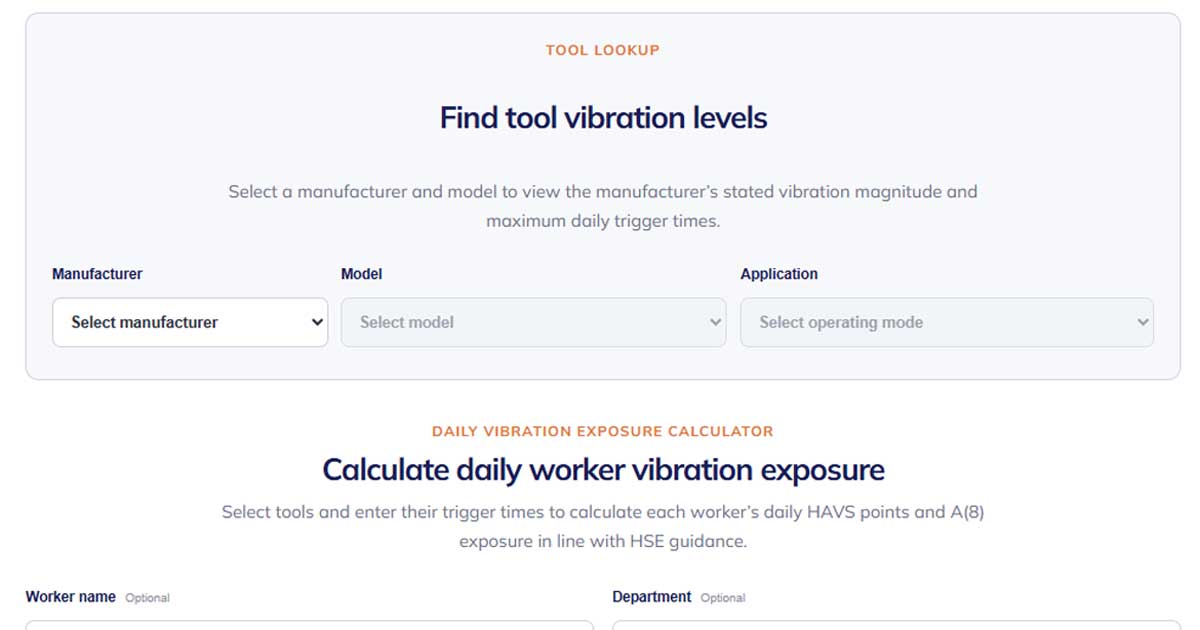
Instead of searching through product manuals and entering every vibration magnitude manually, users can select a manufacturer, tool model and application to view the declared vibration value and maximum daily trigger times.
The database currently includes tool and application data from Bosch, Makita, DeWalt and Hilti. If you have measured workplace data or a tool that is not listed, you can enter the vibration magnitude manually.
With the calculator, you can:
Select the manufacturer and tool model from the database. Where a model has several declared vibration values, choose the application or operating mode that most closely represents the work being completed.
The tool lookup displays the manufacturer-stated vibration magnitude together with the estimated time to reach the EAV and ELV.
Select Add this tool to the exposure calculator. Alternatively, choose Input Tool Manually to enter measured workplace data or assess a tool that is not included in the database.
Enter the time the worker’s hands are actually in contact with the operating tool. Trigger time may be considerably shorter than the total time spent completing the task.
If the worker uses more than one vibrating tool during the day, add each tool and its individual trigger time. The calculator combines their partial exposures automatically.
The results show:
The HSE identifies 100 points as the Exposure Action Value and 400 points as the Exposure Limit Value.
The calculation can be completed without entering contact details. If you want to retain a record, you can email yourself a saved results link and unlock a downloadable PDF report.
Using the spacebands free HAVS calculator provides more than just quick exposure checks. It helps health and safety professionals work more effectively and keep workplaces compliant:
By replacing manual spreadsheets with a modern online solution, employers can improve accuracy, streamline safety processes, and spend more time focusing on prevention rather than paperwork.

While a HAVS calculator is an essential tool for assessing daily vibration exposure, it should be seen as part of a wider safety strategy. Calculations alone cannot prevent injuries - they highlight risks so that employers can take action.
To build a safer approach to vibration management, employers should consider:
By combining the insights from the free HAVS calculator with proactive monitoring and safety processes, employers can strengthen compliance and create a healthier, safer workplace.
Calculating hand-arm vibration exposure is a legal requirement and a vital part of protecting workers’ health. While the traditional HSE HAVS calculator spreadsheet provides a way to do this, it can be time-consuming and difficult to manage across multiple tools and workers.
The spacebands free HAVS calculator makes the process quicker, easier, and more accurate. By instantly calculating daily exposure points, A(8) values, and compliance thresholds, it helps employers reduce risk, save time, and keep clear records for audits.
Start simplifying your vibration monitoring today — try the free HAVS calculator and make HAVS compliance straightforward.
👉 Use the Free HAVS Calculator
A HAVS calculator is a tool used to measure a worker’s daily exposure to vibration from tools and machinery. It calculates values such as exposure points and A(8), helping employers comply with the Control of Vibration at Work Regulations 2005.
Yes, the spacebands calculator uses the same formulas and guidance as the HSE HAVS calculator spreadsheet. The difference is that it’s online, faster to use, easier to share results, and comes with downloadable PDF reports.
The vibration magnitude (m/s²) is usually provided in the tool’s user manual or manufacturer specifications. It can also be measured using vibration monitoring equipment or wearable technology.
Yes. Health surveillance detects early symptoms of HAVS, but a calculator helps you manage exposure proactively before risks become a health issue. Both are essential parts of a complete vibration safety strategy.
Yes. The spacebands free HAVS calculator allows you to add multiple tools per worker and instantly calculates combined daily exposure. Results can be saved and shared to keep accurate compliance records.
The tool database uses manufacturer-stated vibration data for Bosch, Makita, DeWalt and Hilti models and applications.
Manufacturer figures are normally produced under controlled laboratory conditions and may not represent vibration exposure during real workplace use. HSE advises checking that manufacturer data is representative of how the equipment is used, as workplace vibration can sometimes be substantially higher.
Use measured workplace data where it is available and treat the calculator as support for a competent HAVS risk assessment, not a replacement for one.
