




spacebands is a multi-sensor wearable that monitors external, environmental hazards, anticipates potential accidents, and gives real-time data on stress in hazardous environments.
Members of:





Recognition:





A worker can pass a safety induction, understand the risks and still find it difficult to apply that knowledge during a busy shift.
Hand-arm vibration and noise exposure are good examples. Workers may understand that both can damage their health, but recognising how exposure builds across different tasks is less straightforward.
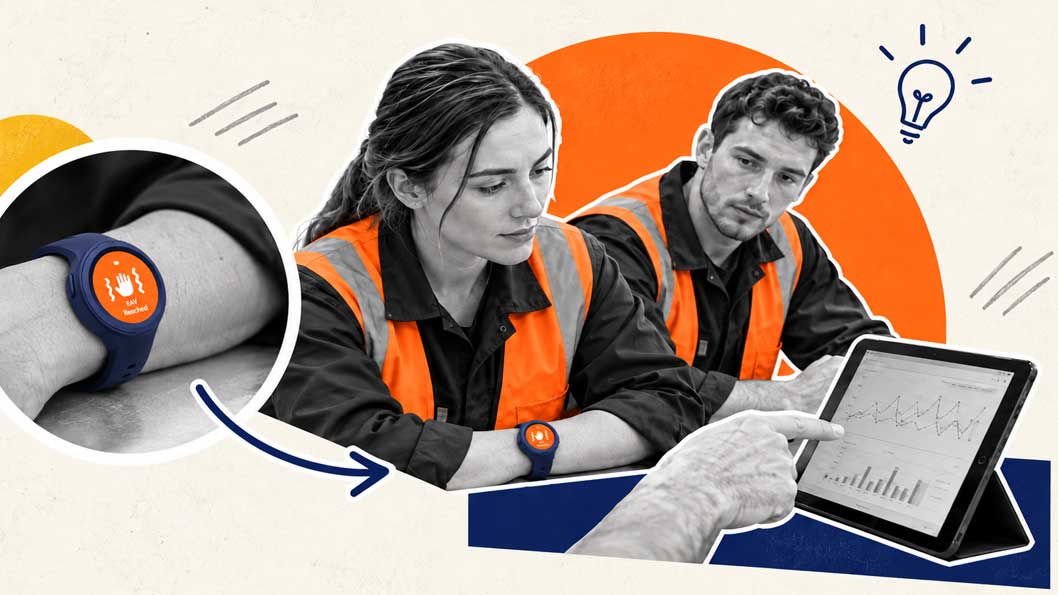
Wearable safety technology can help connect training with everyday work. Exposure records give supervisors something concrete to discuss, while on-device alerts can reinforce an agreed response during a shift.
The value comes from what happens next: a conversation, a change to the task or a better way of controlling exposure.
A training session explains the principles. The workplace puts them to the test.
A worker might move between several vibrating tools, spend longer than expected on a difficult job or work alongside another noisy activity. Those details can be difficult to capture in a generic presentation.
Wearable data can provide a starting point for discussing what happened during real work. Combined with task records and worker feedback, it can help a supervisor ask more useful questions:
This turns a broad reminder to work safely into a discussion about a specific job.
HSE’s training guidance recognises coaching and on-the-job learning as useful training methods. It also recommends checking whether people understand their training and apply it in practice.[1]
Repeated short periods of exposure can be difficult to picture across an entire shift.
During a toolbox talk, a supervisor could use an anonymised exposure record to explain how different parts of the day contributed to the overall picture. Workers can add context about the tasks, tools and working conditions involved.
For example, a team might discover that an awkward finishing task regularly takes longer than planned. That creates an opportunity to discuss equipment selection, maintenance and a different method of work.
The data should prompt investigation. It does not automatically explain which tool caused a reading, why exposure increased or whether someone used the correct technique.
An alert is only useful if the person receiving it understands the response.
Before introducing a wearable, training should cover what each alert means, what action is expected and who can help. Workers should also understand that silence from the device is not proof that every aspect of the task is safe.
Practise the response during induction. Ask the worker to explain what they would do if an alert occurred halfway through a job.
Depending on the risk assessment and agreed procedure, that may involve stopping the task safely, speaking to a supervisor or moving to an activity without the relevant exposure.
Avoid treating an alert as permission to work up to a limit. Controls should already be in place to reduce exposure, and an alert should support those arrangements.
Repeatedly delivering the same presentation to everyone can miss the specific problems affecting a team.
Exposure trends can help identify where a closer look is needed. A supervisor might review a particular task, observe how equipment is being used and ask workers what makes the planned method difficult to follow.
Sometimes additional coaching will help. Sometimes the answer is a better tool, maintenance, a revised work process or a more realistic schedule.
A higher reading does not automatically mean a worker needs retraining. Comparing employees without considering their tasks and conditions can lead to the wrong conclusion.
Use the information to investigate the work before judging the person.
Wearable data can make a short toolbox talk more relevant without turning it into a technical lecture.
Consider this illustrative workshop example:
A supervisor notices that recorded vibration exposure is repeatedly higher on days involving a particular finishing job. The team reviews the pattern and explains that worn consumables make the task take longer.
The response combines a check of the equipment, replacement consumables and a practical demonstration of the approved working method. The supervisor then reviews comparable work to see whether the changes helped.
The learning comes from combining the readings with workers’ experience. A chart alone would not have identified the worn consumables.
Keep each session focused on one question, one practical improvement and one agreed follow-up.
Attendance records show that people were present. They do not show whether a safer method became part of the job.
Wearable exposure trends can contribute to a broader review after training. Pair them with direct observation, worker feedback and checks that the agreed controls are being used.
Compare similar tasks and working conditions wherever possible. Lower exposure during a quiet week does not prove that training worked, just as higher exposure during a different job does not prove it failed.
Useful review questions include:
Treat exposure trends as one source of evidence, alongside an assessment of practical competence.
A successful rollout starts with a clear explanation of the purpose.
Tell workers what the device records, how the information will be used, who can access it and how concerns can be raised. Give them time to practise fitting, using and returning the device.
Use anonymised examples for group discussions where possible. Individual coaching should be supportive, with enough context to understand the job.
Also make the instructions accessible. A brief demonstration and a check of understanding may be more useful than handing everyone a dense technical manual.
Wearables can support training, but they cannot make an unsafe process safe on their own.
For vibration and noise, the priority remains assessing the risk and controlling exposure. Training should explain the working methods and controls that protect people, with monitoring helping teams review what is happening.
Choose equipment suitable for the intended measurement task and understand its limitations. In particular, do not assume every wrist-worn device provides measurements interchangeable with a tool-handle vibration assessment.
Monitoring exposure is also different from monitoring health. It does not diagnose hand-arm vibration syndrome or hearing damage, or replace health surveillance where required.[2]
spacebands combines wearable monitoring of hand-arm vibration and noise exposure with on-device alerts and an analytics dashboard.[3]
Teams can use the resulting exposure records as a starting point for toolbox talks, individual coaching and reviews of working practices. Explain the distinction between alerts on the wearable and reviewing uploaded records in the dashboard, so workers and supervisors understand how their system operates.
The aim is to make each training conversation more specific: what happened, what contributed to it and what needs to change.
Want to bring real exposure data into your safety conversations? Explore spacebands and speak to the team about your workplace.
Wearables can provide exposure information that makes training more relevant to actual tasks. Teams can use it to discuss working methods, practise responses to alerts and review whether agreed changes helped.
No. Workers still need suitable instruction, training and supervision. A wearable is a supporting tool, and workers also need to learn how to use it and understand its limitations.
Use an anonymised example to discuss a specific task. Ask workers what happened, review the controls and agree a practical improvement. Avoid assuming that a reading explains its own cause.
Exposure trends can contribute to that assessment, but they cannot prove it on their own. Compare similar work and combine the data with observation, worker feedback and checks of practical understanding.
[1] HSE, Health and safety training: A brief guide
https://www.hse.gov.uk/pubns/indg345.pdf
[2] HSE, Hand-arm vibration at work: A brief guide
https://www.hse.gov.uk/pubns/indg175.htm
[3] spacebands, product overview
https://www.spacebands.com/
Watch the online demo and see how wearable safety technology helps teams monitor exposure, reduce admin and prove risk is being managed.


We think you'll also find the articles below really useful
Join 5,000 H&S professionals and sign up for the spacebands monthly newsletter and get the latest blogs, free resources, tools, widgets and a dose of health & safety humour.
spacebands is a multi-sensor wearable that monitors external, environmental hazards, anticipates potential accidents, and gives real-time data on stress in hazardous environments.
