


spacebands is a multi-sensor wearable that monitors external, environmental hazards, anticipates potential accidents, and gives real-time data on stress in hazardous environments.
Members of:





Recognition:






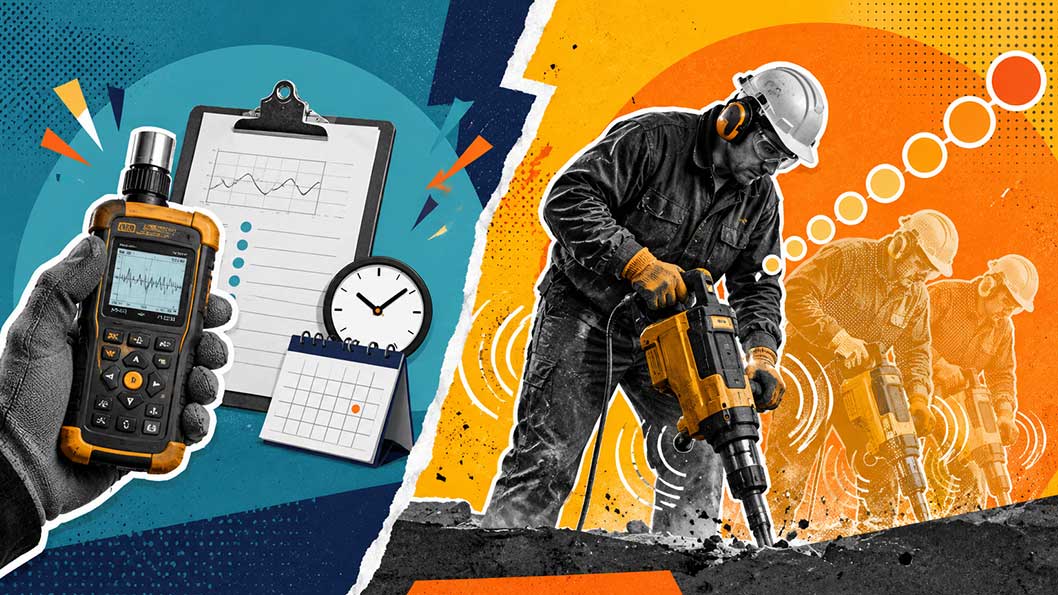
Hand-arm vibration risk assessments have traditionally relied on equipment data, occasional workplace measurements and estimates of how long employees use vibrating tools.
These methods remain an important part of HAVS management. They help employers understand the likely vibration magnitude of a tool, identify higher-risk activities and establish suitable exposure controls.
But a periodic assessment only shows what happened under the conditions observed. It does not necessarily reveal what every worker experiences across changing tasks, tools and working conditions.
For modern safety teams managing mobile workforces, multiple sites and variable workloads, that can leave a significant gap between the exposure documented in a risk assessment and the exposure occurring during day-to-day work.
A competent person may measure vibration at the point where a tool contacts the hand, using specialised equipment and established measurement methods.
Alternatively, employers may use vibration information from manufacturers, suppliers or recognised industry sources. This data can then be combined with estimated trigger times to calculate a worker’s likely daily exposure.
The result is normally expressed as an A(8) value or as HAV exposure points:
This process provides the baseline needed to determine which activities require controls. However, the calculation is only as representative as the vibration magnitude and exposure time entered into it.
That is where periodic assessments can begin to lose sight of real working conditions.
A measurement taken from a particular tool, worker and task represents that combination at that moment.
HSE notes that workplace vibration measurements can vary according to factors including:
HSE’s published vibration data also demonstrates the scale of this variability. For example, angle grinders can produce considerably different vibration levels depending on their size, condition, attachment and application.
A tool measured during one controlled task may therefore behave differently when:
Periodic measurement can establish a useful reference point, but it cannot guarantee that those same conditions continue throughout the following weeks or months.
Daily exposure depends on both vibration magnitude and the time for which the worker is exposed.
This does not mean the whole time a tool is held. It means the time during which the equipment is operating and transmitting vibration into the hands, often referred to as trigger time.
Accurately estimating this across a working day can be difficult. HSE warns that employees are unlikely to provide trigger-time information very accurately and recommends observing representative work where necessary.
Even a carefully observed sample can become outdated when workloads change.
A worker may use several different tools, move between jobs or assist another team. An urgent task may run longer than planned. A seemingly minor additional job late in the shift may push cumulative exposure above the EAV or ELV.
A spreadsheet cannot account for work it was never told happened.
Risk assessments often classify workers according to their role, team or typical tasks. This is practical, but it can create an assumption that people doing similar jobs receive similar exposure.
In reality, exposure is personal and cumulative.
Two employees with the same job title may:
Periodic checks can identify a hazardous process. They are less effective at identifying which individual experienced an unusually high-exposure day.
That matters because the legal limit applies to each employee’s daily exposure, not the average exposure of a team.
Some HAVS systems require workers or supervisors to record tool use at the end of a shift. This may improve the exposure record, but it does not necessarily help prevent an overexposure while work is taking place.
HSE specifically warns that retrospective recording can allow an employee to exceed a set exposure limit before anyone becomes aware of it.
By the time the information reaches the safety team, the opportunity to rotate the task, introduce a break or stop further exposure has already passed.
For prevention, the timing of the information matters almost as much as the information itself.
Continuous monitoring gives safety teams greater visibility of how exposure changes throughout ordinary work.
Rather than relying solely on a periodic sample or recalled trigger time, a wearable system can help identify:
This creates a feedback loop between the risk assessment and the workplace.
Periodic assessment establishes the expected risk. Ongoing monitoring helps reveal when actual working patterns begin to move away from that expectation.
It is equally important not to confuse better data with effective risk reduction.
HSE is clear that monitoring alone does not control vibration risk. Employers must eliminate exposure where reasonably practicable or reduce it as far as reasonably practicable.
Controls may include:
Continuous monitoring should support these decisions, not replace them.
It also does not remove the need for a suitable risk assessment, competent vibration measurement where required or properly established vibration magnitude data.
Periodic measurement and continuous monitoring solve different parts of the problem.
Periodic tool measurement helps safety teams understand the vibration generated by equipment under representative working conditions. Continuous personal monitoring helps them understand how exposure develops across a worker’s actual day.
Used together, they can create a more responsive approach:
This is not about collecting data for the sake of creating another dashboard. It is about giving supervisors and safety teams information they can use to intervene earlier and improve how work is planned.
Periodic checks remain valuable, particularly where work is stable, exposure is predictable and effective controls are already well established.
But many workplaces are neither stable nor predictable. Workers change tasks, equipment deteriorates, workloads fluctuate and actual trigger times differ from planned schedules.
In those environments, relying solely on occasional measurements and estimated exposure can leave safety teams managing yesterday’s conditions.
Continuous monitoring provides an additional layer of visibility. It helps organisations identify changing exposure patterns, test whether controls remain effective and make decisions using information from the work as it is actually being performed.
The goal is not simply to demonstrate that a HAVS assessment was completed.
It is to prevent workers from being harmed between assessments.
Periodic assessments can provide a useful exposure baseline, particularly where tasks are predictable. However, they may not capture changes in tools, working methods, trigger times or individual daily exposure.
There is no universal measurement schedule. Assessments should be reviewed when equipment, processes or working conditions change, or when existing controls may no longer be effective.
Exposure can vary with tool condition, attachments, materials, operator technique, grip force and trigger time. Even the same tool can produce different exposure levels across tasks and workers.
No. Monitoring should support a suitable risk assessment and vibration control programme. It does not replace competent measurement, health surveillance or the employer’s duty to reduce exposure.
Continuous monitoring can highlight individual exposure patterns, workers approaching thresholds and unexpected changes between shifts, sites or tasks. This gives teams better information for preventive action.
Watch the online demo and see how wearable safety technology helps teams monitor exposure, reduce admin and prove risk is being managed.


We think you'll also find the articles below really useful
Join 5,000 H&S professionals and sign up for the spacebands monthly newsletter and get the latest blogs, free resources, tools, widgets and a dose of health & safety humour.
spacebands is a multi-sensor wearable that monitors external, environmental hazards, anticipates potential accidents, and gives real-time data on stress in hazardous environments.
