




spacebands is a multi-sensor wearable that monitors external, environmental hazards, anticipates potential accidents, and gives real-time data on stress in hazardous environments.
Members of:






Recognition:






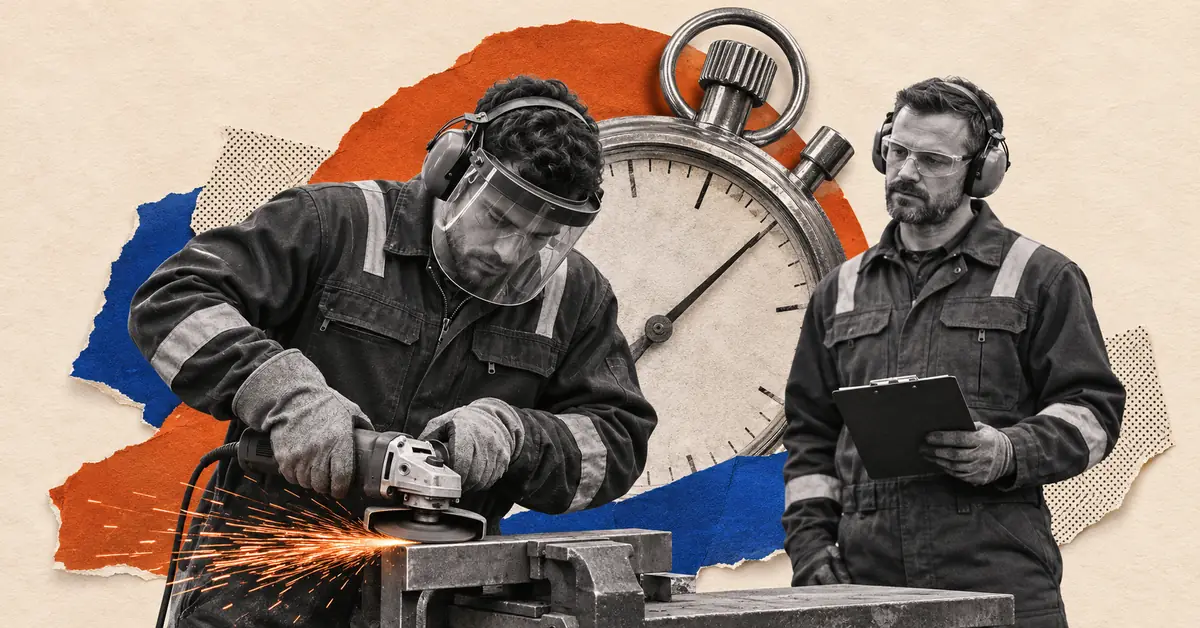
Two fitters sign out the same grinder. Between them, they spend two hours grinding. The supervisor splits the time evenly on the exposure sheet. The figures add up perfectly. There’s just one problem: one fitter did nearly all the grinding.
That’s how a tidy record can hide the person most at risk of hand-arm vibration syndrome (HAVS). Here are six assumptions worth testing the next time you review a shift.
Looking for the legal duties, exposure thresholds or review frequency? Read the full workplace HAVS monitoring guide.
What are the most common HAVS monitoring misconceptions? Employers often confuse booked job time with trigger time, assume tool-sharing splits individual exposure evenly, treat exposure points as a safe allowance, or believe an alert alone manages the risk. Effective HAVS control depends on accurate exposure assessment and changes to the work when risk is identified.
Daily exposure belongs to the individual. Sharing equipment only reduces someone’s exposure if it changes the vibration they experience or the time their hands are exposed. A tool sign-out sheet tells you who had access to a machine. It can’t tell you how the work was divided.
Take the two fitters. At an illustrative in-use vibration magnitude of 6 m/s², an hour of grinding contributes 72 exposure points. If one fitter grinds for 90 minutes and the other for 30, their totals are 108 and 36 points. Recording 72 each hides the fact that the first worker reached the 100-point exposure action value on this job alone. Ask who operated the tool before signing off the record. HSE exposure calculator and points guide.
A manufacturer’s declared vibration value is a starting point. Its usefulness depends on how closely the test represents your task. Check the model, attachment, operating mode and material. A figure for drilling into metal gives you little basis for estimating exposure when someone uses the same machine in hammer mode on concrete.
Ask the supplier for representative data for that operation. Where suitable data is unavailable, arrange for a competent person to take workplace measurements. Record which value you chose and why, so the next supervisor can tell when the assumption needs revisiting. HSE guidance on assessing vibration risks.
Compare the exposure needed to finish the same job. A lower-vibration tool may reduce exposure considerably, but productivity matters. A blunt attachment or an underpowered machine can leave someone holding the trigger for longer.
For example, a tool operating at 8 m/s² for 30 minutes contributes 64 points. Another operating at 6 m/s² for an hour contributes 72 points. Both figures are illustrative. When trialling equipment, time the work on the same material and compare the points per completed cut, hole or finished part. HSE calculation method · HSE guidance on tool selection and maintenance.
Plan work against each worker’s daily exposure. The hand-arm vibration exposure limit value is 5 m/s² A(8), equivalent to 400 points in a day. A lighter shift tomorrow is no basis for assigning more vibrating work today once someone is at the daily limit.
Regulation 6(5) permits weekly averaging only in specific circumstances. Among other conditions, exposure must usually be below the action value, vary markedly and only occasionally exceed the limit. For routine planning, give the supervisor a lower-exposure task they can assign when a job overruns. Control of Vibration at Work Regulations 2005, regulation 6.
Employers must assess and control vibration risk. HSE says daily exposure monitoring is generally unnecessary and identifies targeted monitoring as a way to check assumptions. For a repetitive job, observing representative cycles may answer the question. For a maintenance fitter moving between planned work and call-outs, an individual record can reveal exposures a spot check misses.
Wrist-worn monitoring is particularly useful when the job changes repeatedly. ISO/TS 22270:2026 covers systems worn on the hand, wrist or arm and describes the value of following individual exposure patterns over time. With spacebands, the worker puts on the wearable and can switch tools without logging each change. The worker receives threshold alerts during use, and the supervisor can review the record after charging. HSE measurement and monitoring guidance · ISO/TS 22270:2026 · How spacebands tracks exposure.
An alert tells you when to act. Closing the alert still leaves a practical question: what changed for the worker? If a fitter reaches a warning point while removing seized bolts, the supervisor needs to check the remaining task before assigning another vibrating tool.
Record the decision beside the alert. For example: “Moved remaining bolts to the workshop for mechanical removal. Supervisor to check the method on the next batch.” That entry tells the next shift what to do differently and gives the safety manager something specific to verify. HSE guidance on monitoring and exposure control.
Both tools can expose the worker’s hands to vibration. Include each contribution in the daily total. A task such as marking out may provide time away from vibration. HSE calculator guide.
Add their exposure points. A(8) values combine differently, so enter each tool’s magnitude and trigger time separately in the calculator to obtain the daily A(8). HSE L140, exposure points system.
Count the periods when vibration reaches the worker’s hands. Observe a few cycles. Setting up the workpiece, measuring it and clearing away can account for much of the booked hour. HSE risk assessment guidance.
Yes. Encourage workers to report tingling, numbness or finger blanching promptly. Follow the occupational health process and review their work. An exposure alert cannot diagnose or rule out HAVS. Regulation 7, health surveillance.
Observe both doing the task. Check operating time, attachments, workpiece, tool condition and how the monitoring equipment was used. A difference is a reason to investigate before drawing a conclusion about either worker. HSE guidance on variability.
Putting this into your next risk assessment? Use the workplace HAVS monitoring guide for the action and limit values, review triggers and a shift-planning example.
Watch the online demo and see how wearable safety technology helps teams monitor exposure, reduce admin and prove risk is being managed.



We think you'll also find the articles below really useful
Join 5,000 H&S professionals and sign up for the spacebands monthly newsletter and get the latest blogs, free resources, tools, widgets and a dose of health & safety humour.
spacebands is a multi-sensor wearable that monitors external, environmental hazards, anticipates potential accidents, and gives real-time data on stress in hazardous environments.
