






spacebands is a multi-sensor wearable that monitors external, environmental hazards, anticipates potential accidents, and gives real-time data on stress in hazardous environments.
Members of:





Recognition:



Wearable technology is changing how organisations monitor hand-arm vibration exposure.
Traditional HAVS assessments provide a snapshot of vibration levels from specific tools and activities. Wearable monitoring builds on this by helping employers understand how exposure develops across a worker’s full shift, including changes between tools, tasks and working conditions.
Published in 2026, ISO/TS 22270 provides the first dedicated international framework for monitoring hand-transmitted vibration using devices worn on the hand, wrist or forearm.
Its publication is a significant development for wearable HAVS monitoring. It formally recognises the role that on-body devices can play in improving the visibility, management and reduction of workplace vibration exposure.
ISO/TS 22270:2026 is titled:
Mechanical vibration — Practical guidance and requirements for the monitoring and measurement of hand-transmitted vibration on the hand, wrist or forearm
The Technical Specification applies to systems worn on the body to evaluate daily hand-arm vibration exposure in the workplace.
These devices are referred to as on-body monitors.
The specification provides guidance for both manufacturers and organisations using wearable HAVS monitoring systems. It covers areas including:
This gives wearable HAVS monitoring a clearer and more consistent technical foundation.
Rather than treating wearable devices as an emerging alternative with no agreed framework, ISO/TS 22270 establishes the considerations manufacturers should address when developing and validating their systems.

One of the most significant aspects of the specification is its recognition of the practical benefits offered by wearable monitoring.
ISO/TS 22270 highlights how compact on-body systems can make it easier to monitor an individual’s exposure over a full working day, multiple shifts or even longer periods.
This can provide employers with a more complete understanding of:
The specification also recognises that wearable monitoring can reduce the need for specialist technicians to be present throughout every measurement period. Devices can be fitted by workers with appropriate basic training, with exposure data captured and downloaded automatically.
This makes continuous HAVS monitoring more practical and scalable across larger workforces.
ISO 5349 remains the established standard for measuring and evaluating hand-transmitted vibration at the point where vibration enters the hand.
ISO/TS 22270 addresses a different but complementary type of measurement: monitoring vibration using a device worn on the hand, wrist or forearm.
Because a wearable sensor is positioned away from the gripping surface, the vibration recorded at the device is not automatically identical to the vibration at the tool handle.
ISO/TS 22270 therefore explains how on-body systems can estimate vibration at the gripping zone by applying an appropriate vibration conversion function.
This allows wearable devices to supplement traditional measurements with detailed information about actual exposure patterns across the working day.
The specification also confirms that exposure-time data collected through wearable monitoring can be combined with ISO 5349-1 measurement data to produce an ISO 5349-1-compliant exposure evaluation.
This is an important distinction. Wearable monitoring does not need to replace every existing HAVS assessment method to provide significant value.
Instead, it can help employers move from occasional estimates towards a more continuous, evidence-led approach to managing exposure.

Vibration changes as it travels from a tool through the hand and towards the wrist or forearm.
A wearable HAVS monitoring system therefore needs to account for the difference between vibration at the sensor and vibration at the gripping surface.
ISO/TS 22270 explains that this can be achieved by applying a suitable conversion function to the raw monitoring data.
The conversion function may take account of:
The specification also acknowledges that vibration transmission can vary between workers and can be affected by factors such as grip force, posture and the way a tool is being used.
By setting out these considerations, ISO/TS 22270 gives manufacturers a clearer framework for developing and validating wearable monitoring technology.
The specification sets out several important principles intended to improve the reliability, consistency and transparency of on-body HAVS monitoring.
Where possible, monitoring should take place simultaneously across three axes.
This allows the system to capture vibration travelling in different directions and helps provide a more complete assessment of the vibration experienced by the wearer. The monitoring axes should also be reported and, where practical, aligned with the coordinate system used in ISO 5349-1.
The position and fit of a wearable device can affect the monitoring result.
Manufacturers should therefore provide clear instructions explaining where and how the device should be worn.
ISO/TS 22270 also states that on-body devices should be compact and lightweight, helping to ensure they do not interfere with the worker’s normal activities or materially change the way vibration is transmitted.
The specification expects manufacturers to demonstrate how effectively an on-body system estimates vibration at the machine handle.
Comparative tests should use tools and tasks representative of real working conditions, including different types of continuous and impact equipment.
Testing can compare results from the wearable system with measurements made using equipment compliant with ISO 5349-1 and ISO 8041-1.
This supports greater confidence in wearable monitoring results and gives users more information when evaluating different systems.
A suitable wearable monitoring system should produce consistent results when it is removed, refitted and used by different workers under comparable conditions.
ISO/TS 22270 recommends testing repeatability and reproducibility using consistent vibration sources. This helps manufacturers understand and communicate the uncertainty associated with device positioning and differences between individuals.
The specification explains that systems should have a means of confirming that sensors and signal processing are operating correctly.
This can include calibration, mechanical sensitivity checks or internal self-testing.
Where a self-check identifies that a device is outside its predefined operating limits, the system should flag the affected data and alert the user.
Wearable monitoring frequently takes place automatically and without a technician supervising every measurement.
ISO/TS 22270 therefore says systems should be able to identify errors and artefacts that could affect the results, such as overloads, connection failures or power issues.
These requirements support more reliable unattended monitoring across real working environments.
The specification places significant emphasis on transparency.
Reports should include information about:
This enables employers to understand how the results were generated and use the data appropriately when managing exposure.

ISO/TS 22270 identifies several advantages associated with on-body monitoring systems.
Traditional vibration measurements are often based on individual tools or short observation periods.
Wearable devices can monitor exposure across longer periods, helping employers understand how vibration accumulates as workers move between tools and tasks.
Tool-based assessments provide valuable information about vibration emissions, but workers do not always use tools in exactly the same way or for the same duration.
A personal wearable monitor follows the worker, creating an exposure record based on their actual working day.
Long-term monitoring can highlight patterns that would be difficult to identify through occasional measurements alone.
This can include:
ISO/TS 22270 recognises that these patterns can help organisations target their control measures more effectively.
On-body monitoring systems can be assigned to individual workers.
This creates opportunities for personalised warning levels, exposure limits and restrictions based on the individual’s circumstances.
For example, employers may choose to apply lower internal alert thresholds for workers who have previously reported symptoms or who require additional controls.
Compact wearable systems make it possible to monitor many workers across multiple shifts.
This creates larger data sets that can reveal trends and risks that would otherwise remain hidden.
The result is a more proactive approach to HAVS management, based on evidence collected from normal working conditions rather than estimates alone.
ISO/TS 22270 does not create a new legal requirement to use wearable HAVS devices.
In the UK, employers must continue to comply with the Control of Vibration at Work Regulations 2005.
These regulations require employers to:
Wearable monitoring can support these responsibilities by giving employers clearer information about when, where and how exposure is occurring.
It can also help demonstrate that exposure is being monitored and managed over time, rather than relying entirely on static estimates or self-reported tool-use durations.
The publication of ISO/TS 22270 is an important milestone for wearable safety technology.
It confirms that on-body vibration monitoring has a legitimate and valuable role in modern HAVS risk management.
The specification does not suggest that every wearable device will automatically produce the same result. Instead, it creates a framework for better system design, stronger validation and clearer communication between manufacturers and users.
For employers, this should make it easier to evaluate wearable monitoring systems based on meaningful technical criteria.
For manufacturers, it provides a clearer route for demonstrating how their technology works, how it has been tested and how its results should be interpreted.
Most importantly, it supports a shift towards more continuous and personalised exposure management.
Rather than relying only on occasional measurements and estimated trigger times, organisations can use wearable technology to understand exposure as it happens across real working days.
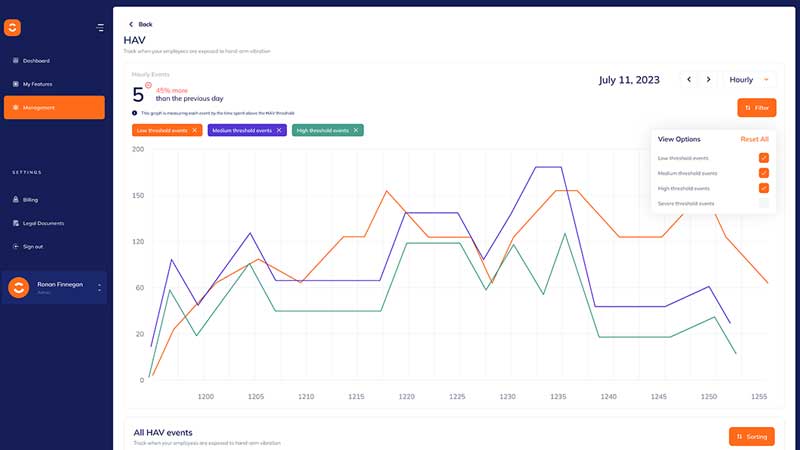
spacebands is a wrist-worn workplace exposure monitoring system designed to help employers understand and manage individual hand-arm vibration exposure.
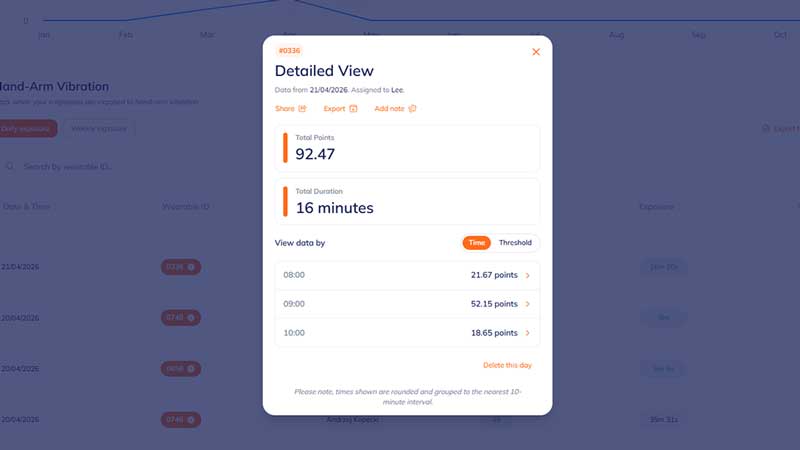
The wearable monitors vibration throughout the working day and calculates each worker’s exposure using A(8) values and HAV exposure points.
Workers receive haptic alerts as they approach key exposure thresholds, helping them take action before limits are exceeded.
When devices are returned to their charging station, exposure records are uploaded to the spacebands dashboard. Health and safety teams can then review exposure by worker, team, date and reporting period.
This provides organisations with:
ISO/TS 22270 represents a positive step towards wider confidence in wearable HAVS monitoring.
For organisations looking to move beyond occasional measurement and gain greater visibility of real workplace exposure, wearable technology provides a practical and scalable way forward.
ISO/TS 22270
Guidance for wearable/on-person hand-transmitted vibration monitoring systems:
https://www.iso.org/standard/87058.html
ISO 5349-1:2001
General requirements for measuring and evaluating exposure to hand-transmitted vibration:
https://www.iso.org/standard/32355.html
ISO 5349-2:2001
Practical guidance for measurement at the workplace:
https://www.iso.org/standard/27511.html
ISO/TS 22270:2026 provides guidance and requirements for monitoring hand-transmitted vibration using devices worn on the hand, wrist or forearm. It covers areas such as sensor positioning, validation, signal processing, system checks and reporting.
Yes. The specification recognises the value of wearable systems for monitoring vibration exposure over longer periods and identifying exposure patterns across real working days.
No. ISO 5349 remains the established standard for measuring vibration at the point where it enters the hand. ISO/TS 22270 complements it by providing a framework for body-worn monitoring systems.
Yes. Wearable devices can help employers track individual exposure across multiple tools and tasks, identify unusual exposure patterns and take action before workers exceed internal or legal thresholds.
Employers should consider how the system has been validated, where it is worn, whether it measures across three axes, how it accounts for vibration transmission, how it checks data quality and how clearly results are reported.
