




spacebands is a multi-sensor wearable that monitors external, environmental hazards, anticipates potential accidents, and gives real-time data on stress in hazardous environments.
Members of:





Recognition:






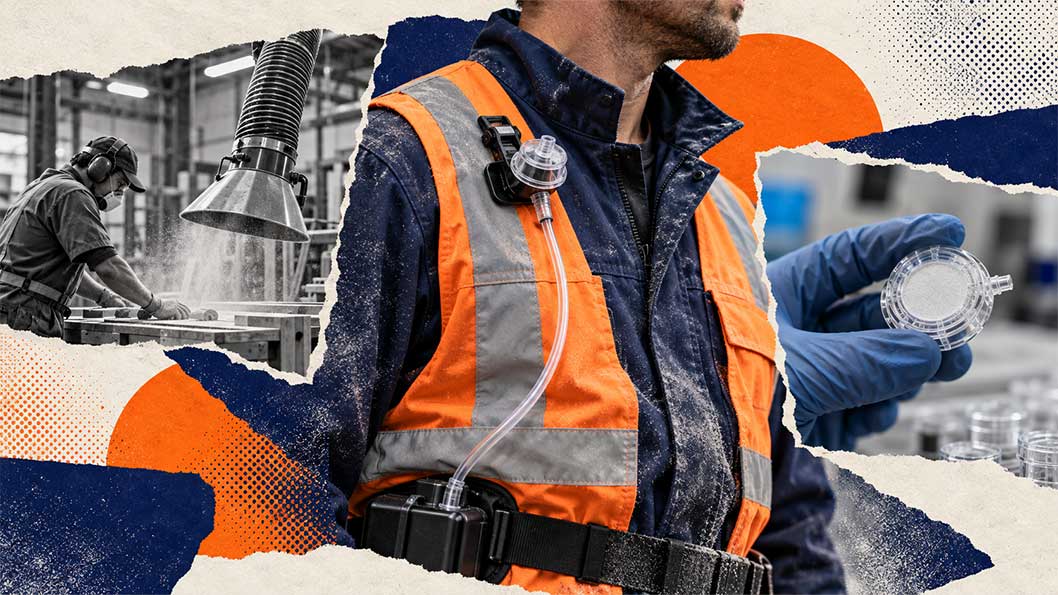
Dust exposure is usually measured by sampling the air close to a worker’s nose and mouth, then calculating the concentration of the relevant dust or substance. Real-time monitors can add a different view: showing when particle levels rise during the working day.
The useful question is not simply “How dusty is this workplace?” It is “What are people exposed to, for how long, and are our controls doing enough?”
For health and safety managers, understanding the difference between sampling, live readings and laboratory analysis makes it easier to commission the right assessment and act on the results.
Cutting, grinding, sanding and handling powders can release airborne dust. Some of the particles that matter most for health are too small to see under normal conditions. A room that looks clear is not proof that exposure is adequately controlled.
Different materials also create different hazards. Stone and concrete can generate respirable crystalline silica; wood dust can cause asthma. The material, process and existing controls should shape the assessment. [1]
Occupational hygiene uses particle fractions linked to where airborne material can travel in the respiratory system:
• Inhalable dust is the fraction that can enter the nose and mouth.
• Thoracic dust is the fraction that can pass beyond the larynx.
• Respirable dust is the fraction that can reach the gas-exchange region deep in the lungs.
These are sampling conventions, not interchangeable labels. Choose the fraction relevant to the substance and exposure limit. [2]
A worker wears a small pump connected to a sampling head positioned in their breathing zone, usually on the upper chest or lapel. A suitable sampler collects the required particle fraction on a filter.
The pump draws a measured volume of air through the sampler. Gravimetric analysis determines the mass collected, with appropriate blank corrections. Concentration is calculated as dust mass divided by air volume, usually expressed in milligrams per cubic metre (mg/m³).
The sampler, flow rate and analytical method must suit the assessment. Flow checks and careful sample handling help make the result reliable. [2]
Many direct-reading dust monitors use light scattering to estimate particle concentrations. Their main practical advantage is timing: a recorded peak can be matched to an activity, such as emptying a bag or cleaning equipment.
That helps teams investigate where dust comes from and compare conditions before and after a change. It also gives context that a single shift-average result cannot show.
However, an optical reading is an estimate influenced by the properties of the dust and the instrument’s calibration. Particle size, composition and environmental conditions can affect the response. Appropriate comparison with filter-based measurements may be needed. [3]
PM1, PM2.5 and PM10 describe particle size categories. They do not identify chemical composition, and they should not automatically be treated as occupational inhalable or respirable measurements.
A generic PM monitor cannot tell you how much of its reading is crystalline silica. Measuring respirable crystalline silica requires a method that identifies that substance, commonly collecting a respirable sample for analysis using infrared spectroscopy or X-ray diffraction. [4]
This matters when selecting equipment. Ask whether a device measures the substance and fraction you need, or provides an indicator that helps you investigate exposure.
HSE’s EH40 publication lists workplace exposure limits (WELs) for Great Britain. The correct comparison must match the substance, particle fraction and reference period.
For respirable crystalline silica, the WEL is 0.1 mg/m³ as an eight-hour time-weighted average. This is a limit for the silica fraction, not for all dust in the air. [5]
An eight-hour time-weighted average accounts for concentration and duration. In a simplified example, exposure to one substance at 0.20 mg/m³ for two hours and 0.02 mg/m³ for six hours gives:
(0.20 × 2 + 0.02 × 6) ÷ 8 = 0.065 mg/m³
This illustrates the calculation only. A competent assessment must account for the actual shift, unmeasured periods and the quality of the evidence.
Staying below a WEL does not, by itself, establish adequate control. COSHH also requires good control practice; exposure to carcinogens, mutagens and asthmagens must be reduced as low as reasonably practicable. [6]
The often-quoted figures of 10 mg/m³ inhalable dust and 4 mg/m³ respirable dust are COSHH trigger concentrations over eight hours. They are not blanket safe limits. Harmful dust can require control below these values, and substance-specific WELs may be much lower. [7]
A fixed monitor can help investigate background conditions or dust escaping from a process. But the concentration at that location may differ from the air around a worker who moves between tasks or works close to the source.
For comparison with WELs, HSE advises requesting personal samples. Static measurements can provide useful supporting information about control performance and the spread of contamination. [8]
For example, a monitor across a workshop could miss a brief exposure during bag tipping. Equally, a monitor beside one machine does not describe everybody’s exposure across the site. Decide what question each measurement is intended to answer before choosing its location.
A useful monitoring strategy considers the materials, tasks, workers and conditions that influence exposure. Similar job titles do not necessarily mean similar exposure: one person may spend much longer near the source.
Agree which workers and activities to assess, how representative the measurements need to be, and whether repeated sampling is necessary. Exposure can vary between shifts and days, so one low result should not be treated as permanent proof of control. [9]
Include cleaning and maintenance, as well as production. Record what happened during sampling: the material, task duration, extraction in use and any unusual conditions. Ask for a report that explains the findings, identifies gaps and recommends actions and future monitoring. [8]
Dust readings are most useful when they lead to a practical decision. If a task produces a concerning result, review how the dust is generated and controlled at source.
Depending on the process, improvements may include using a lower-dust method, enclosing the operation, suitable water suppression or effective local exhaust ventilation. Cleaning methods matter too: dry sweeping and compressed air can put settled dust back into the air. Suitable vacuum or wet-cleaning methods can reduce that problem. [1, 7]
Check that workers can use the controls properly in normal working conditions. Where respiratory protective equipment is required, select it for the hazard and ensure it is suitable for the wearer and task. Tight-fitting masks require appropriate face-fit testing. [1]
After changes, use suitable checks and further measurements to assess whether control has improved. Exposure monitoring evaluates the work environment; health surveillance assesses workers for early signs of work-related ill health where required. One does not replace the other. [10, 11]
Before commissioning a survey or choosing a monitor, define the decision you need to make. Are you assessing exposure to a specific substance, locating a dust source or checking an improvement?
Ask what the result measures, whose exposure it represents and what action it should trigger. A useful report should leave you with a clear next step, not just a concentration to file away.
Explore more practical guidance on managing workplace exposure on the spacebands blog.
Personal air sampling measures airborne dust close to the worker’s breathing zone. The collected material is analysed and related to the volume of air sampled. Direct-reading instruments can add information about changes during tasks. [2, 3]
Dust mass concentration is commonly reported in mg/m³, meaning milligrams of dust per cubic metre of air. Some devices display µg/m³: 1,000 µg/m³ equals 1 mg/m³. Always check the substance, fraction and averaging period alongside the units. [5]
A generic particle monitor does not identify crystalline silica. Silica exposure assessment needs a substance-specific analytical method, commonly applied to a collected respirable dust sample. [4]
There is no single interval suitable for every workplace. The monitoring strategy should reflect risk, previous results, exposure variability and changes to materials, processes or controls. A competent occupational hygienist can advise on the programme. [9]
No. Wearing a mask does not establish that exposure is adequately controlled. Monitoring may still be appropriate to assess exposure and control performance, alongside suitable selection and use of respiratory protection. [10]
[1] HSE — Construction dust
https://www.hse.gov.uk/construction/healthrisks/hazardous-substances/construction-dust.htm
[2] HSE — MDHS14/4 Sampling and gravimetric analysis of aerosols
https://www.hse.gov.uk/pubns/mdhs/pdfs/mdhs14-4.pdf
[3] NIOSH — The Use of Real-time Respirable Dust Monitors
https://www.cdc.gov/niosh/blogs/2018/dust-monitors.html
[4] HSE — MDHS101 Crystalline silica in respirable airborne dust
https://www.hse.gov.uk/pubns/mdhs/pdfs/mdhs101.pdf
[5] HSE — EH40 Workplace exposure limits
https://www.hse.gov.uk/pubns/priced/eh40.pdf
[6] HSE — Workplace exposure limits and control requirements
https://www.hse.gov.uk/coshh/basics/exposurelimits.htm
[7] HSE — EH44 Dust in the workplace
https://www.hse.gov.uk/dust/assets/docs/eh44.pdf
[8] HSE — G409 Exposure measurement and air sampling
https://www.hse.gov.uk/pubns/guidance/g409.pdf
[9] HSE — HSG173 Monitoring strategies for toxic substances
https://www.hse.gov.uk/pubns/priced/hsg173.pdf
[10] HSE — Monitoring the control of exposure to hazardous substances
https://www.hse.gov.uk/coshh/basics/monitoring.htm
[11] HSE — Health surveillance for workers exposed to RCS
https://www.hse.gov.uk/pubns/books/healthsurveillance.htm
Watch the online demo and see how wearable safety technology helps teams monitor exposure, reduce admin and prove risk is being managed.



We think you'll also find the articles below really useful
Join 5,000 H&S professionals and sign up for the spacebands monthly newsletter and get the latest blogs, free resources, tools, widgets and a dose of health & safety humour.
spacebands is a multi-sensor wearable that monitors external, environmental hazards, anticipates potential accidents, and gives real-time data on stress in hazardous environments.
