




spacebands is a multi-sensor wearable that monitors external, environmental hazards, anticipates potential accidents, and gives real-time data on stress in hazardous environments.
Members of:





Recognition:





Hand-arm vibration syndrome (HAVS) is preventable, but the damage it causes can be permanent. In 2027, a spreadsheet, an annual toolbox talk and a folder full of generic tool figures should not be mistaken for an effective HAVS management programme.
Good HAVS risk management is active. It connects the risk assessment to the work taking place, gives workers useful information while there is still time to act and helps management teams turn exposure data into preventative action.
The legal foundations remain familiar. Under the Control of Vibration at Work Regulations 2005, employers must assess and control vibration risks, provide suitable information and training, and arrange health surveillance where required. The daily exposure action value (EAV) is 2.5 m/s² A(8), equivalent to 100 exposure points, while the exposure limit value (ELV) is 5 m/s² A(8), or 400 points. The ELV must not be exceeded.
What is changing is what organisations can reasonably see, measure and do. Here is what a strong, modern approach looks like in practice.
A HAVS risk assessment should identify who may be at risk, provide a reasonable estimate of workers’ exposure and set out the controls required. It should also be reviewed when work, equipment or exposure changes, and periodically even when no obvious change has taken place.
The weakness in many traditional assessments is not the calculation itself. It is the assumptions feeding it.
Trigger-time estimates may be based on memory, observation or planned task durations. Tool vibration figures may come from manufacturer data that does not fully reflect the condition of the equipment, the material being worked on, the accessory fitted or the way the tool is used. A calculation can be mathematically correct and still give a poor picture of somebody’s working day.
Good practice in 2027 means comparing planned exposure with evidence from real work. That could include representative tool measurements, task observations, maintenance data and personal exposure monitoring. The aim is not to collect data for its own sake, but to test whether the assumptions in the risk assessment remain credible.
Monitoring does not make vibration safe. The priority is still to remove the risk or reduce exposure as far as is reasonably practicable.
Effective controls can include:
Job rotation should not become a way of distributing excessive risk more widely, and purchasing a tool advertised as low vibration is not the end of the assessment. Controls need to be appropriate for the real task and checked to make sure they are effective.
In other words, measurement should support the control strategy, not become the control strategy.
HAV exposure accumulates across every vibrating tool and task completed during a shift. Looking at one tool in isolation can therefore miss the bigger picture.
A worker might use a grinder, breaker and impact wrench for relatively short periods. None of those activities may appear exceptional on its own, but their combined exposure can take the worker past the EAV or ELV.
Good HAVS management brings those events together at individual level. It helps answer practical questions such as:
The HSE does not require employers to monitor and record vibration exposure continuously. However, monitoring can help organisations understand how long tools are really used and strengthen the evidence behind their risk assessment. Used properly, it turns HAVS management from an occasional calculation into a clearer view of risk across the working day.
A report reviewed days or weeks later may help with investigation and long-term planning. It cannot change the exposure that has already happened.
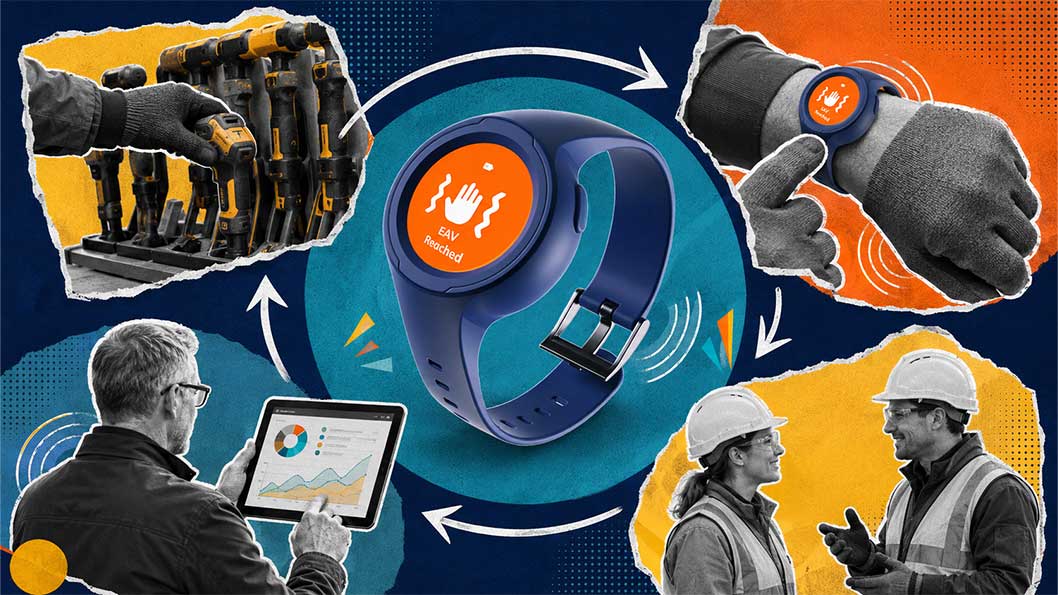
By 2027, good risk management should include a way to communicate increasing exposure to the person at risk. Real-time EAV and ELV warnings can alert workers when regulatory thresholds are reached, giving them an immediate prompt to stop, report the event or follow the organisation’s agreed control procedure.
This does not transfer responsibility from the employer to the worker. Employers must still eliminate or reduce risk, provide suitable equipment and organise the work safely. A warning is an additional layer of protection that makes exposure visible at the point of work.
It can also improve understanding. HAVS is a long-term occupational health risk and the consequences may feel remote. A clear on-device warning connects the hazard to the task taking place now, helping workers make informed decisions before further exposure occurs.
An exposure record shows what happened. A management action helps prevent it happening again.
When a worker reaches or exceeds a threshold, the response should go beyond acknowledging an alert. The event should prompt a proportionate review of what contributed to the exposure and whether further controls are required.
Follow-up actions might include:
Recording the action, owner, date and outcome creates accountability. It also provides evidence that the organisation is learning from exposure rather than simply accumulating alerts.
This is the difference between passive monitoring and proactive prevention: the data has somewhere to go.
Health surveillance is required for employees who are likely to be regularly exposed above the EAV despite controls, or who are otherwise considered at risk. Its purpose is to identify symptoms early, help prevent disease progression and check whether existing controls are effective.
A strong programme makes it easy for workers to report tingling, numbness, loss of strength or dexterity, finger blanching and other possible symptoms without fearing that honesty will automatically cost them their job. Employees should understand why surveillance is taking place and what will happen if symptoms are identified.
Health surveillance must also feed back into prevention. Where a clinician makes recommendations or patterns emerge across a workforce, the organisation should review the affected person’s exposure and the effectiveness of its controls.
Exposure data is not a diagnosis and technology does not replace competent occupational health advice. Used together, however, exposure records and health surveillance can provide a much more useful picture than either can provide alone.
Good HAVS management needs both immediate intervention and longer-term oversight.
Individual alerts may highlight a shift that needs attention. Trend data can reveal the systemic issues behind it: a tool type associated with repeated high exposure, a process that regularly pushes workers towards the EAV, a team that needs additional support or a control measure that is not delivering the expected improvement.
Useful reporting should help managers move from asking “How many alerts did we have?” to asking:
Clear historical records can also support internal audits, regulatory inspections and the investigation or defence of future claims. They should show not only exposure information, but how the organisation assessed the risk, communicated it and responded.
Cases of HAVS, health surveillance referrals and compensation claims are important measures, but they are lagging indicators. By the time they rise, harm may already have occurred.
A proactive programme also tracks indicators that can be influenced now, such as:
The goal is not to create a bigger dashboard. It is to spot weaknesses early enough to do something about them.
A good system should allow you to answer yes to the following:
If several answers are no, the problem is unlikely to be a lack of data alone. It is usually the gap between identifying exposure and acting on it.
The fundamentals of HAVS risk management have not changed: assess the risk, reduce exposure, inform workers and protect their health.
What good looks like in 2027 is a more connected version of that process. The risk assessment reflects real work. Workers receive timely warnings. Managers can identify patterns. Threshold events prompt visible, accountable action. The organisation can then check whether its interventions have actually reduced risk.
spacebands helps organisations make that shift. Our wearable tracks personal HAV exposure during real working activity, provides workers with real-time EAV and ELV warnings, and uploads exposure data for management review. With actions recorded against alerts, teams can document steps such as tool rotation, training or further investigation and build a clearer audit trail of prevention.
Because effective HAVS management should do more than record yesterday’s exposure. It should help prevent tomorrow’s harm.
The daily exposure action value for hand-arm vibration is 2.5 m/s² A(8), equivalent to 100 exposure points. When exposure reaches this level, employers must introduce measures to reduce it and provide health surveillance where workers are regularly at risk.
The daily exposure limit value is 5 m/s² A(8), equivalent to 400 exposure points. This is the maximum daily exposure permitted under the Control of Vibration at Work Regulations 2005 and must not be exceeded.
No. The HSE states that there is no legal requirement to continually monitor and record vibration exposure. However, monitoring can help employers understand actual tool use, validate risk assessments and identify where further controls are needed.
Reaching the EAV should trigger the organisation’s agreed control process. This may involve stopping or changing vibrating work, reviewing the task and tools, reducing further exposure, recording follow-up actions and confirming that suitable health surveillance is in place.
No. A wearable can provide evidence about personal exposure and help workers and managers respond sooner, but it does not replace a suitable risk assessment, effective control measures, training or health surveillance.
Watch the online demo and see how wearable safety technology helps teams monitor exposure, reduce admin and prove risk is being managed.



We think you'll also find the articles below really useful
Join 5,000 H&S professionals and sign up for the spacebands monthly newsletter and get the latest blogs, free resources, tools, widgets and a dose of health & safety humour.
spacebands is a multi-sensor wearable that monitors external, environmental hazards, anticipates potential accidents, and gives real-time data on stress in hazardous environments.
